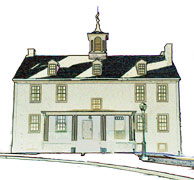
| The Society attempts to chronicle the history and development of theLower Merion region. History is a collection of biographies of those whopreceded us. To better identify these ancestors, the Society hascompiled a listing of more than 15,500 burial records from some of the older burialgrounds in the region. This might sound like a straight forwardproject, but each cemetery has site specific problems that requiredetailed research. For example, since many of the older burial groundshave lost or incomplete burial records, our researchers had to visit eachburial ground and record from the headstone the name and dates. In somecases, due to years of wear, the inscriptions were faint and required a"rubbing" of the headstone to bring out the information. More of achallenge were those plots that had no headstone. In these situations wehave had to research secondary sources to determine who was buriedwhere. Lower Merion's burial sites can be divided into three timeperiods, each telling us a story of the area's growth and development.The three groupings are: the Ancient, the Church Affiliated, and theSuburban Park. The Ancient burial sites are the oldest sites. They are the MerionMeeting of the Religious Society of Friends (Quakers) (1682), and theirsurrounding neighbors, Old Haverford Meeting (1683), Radnor Meeting(1693), and Haverford Meeting (1827). Also included in this grouping arethe small family cemeteries that belonged to the local plantation andbusiness owners. The sites that can still be identified are theLlewellyn Family (early 1700's), the Harrison Family (1719), and the BickingFamily (1782). The Church Affiliated, as the name implies, are the cemeteries that areassociated with a religious community. These are St. Paul's EvangelicalLutheran (c1765), Lower Merion Baptist (1808), Gladwyne United Methodist(1830), Church of the Redeemer (1879), The Independent Order of Odd Fellows (mid-1880's), Church of St. Asaph (1888), and St. Christopher's(1950). The Suburban Park was conceived in the late 19th century.During this period, cemeteries were located outside of urban areas inpastoral locations in order to promote a peaceful and undisturbedresting place. Predominantly non-denominational, they were a place forthe family to visit, to return to nature, to meditate and reflect. Theseare West Laurel Hill (1869), Merion Memorial Park (1888), Westminister(1893), Har Hazaitim (Har Hazaysim) (1896), and Calvary Cemetery (1945). |  | Merion Meeting Burial Records - founded 1682 |